

Every winter, we get calls from homeowners who’ve noticed water stains on their ceilings, icicles hanging from their eaves that have turned into something more alarming, or paint bubbling on interior walls near the roofline. In most cases, the culprit is an ice dam — and in most cases, the ice dam itself is only half the problem.
Here’s what’s actually happening, and what you can and can’t do about it.
How Ice Dams Form
An ice dam forms when heat escapes from your living space up through the roof deck, warming the upper portions of the roof surface. Snow on those warmer sections melts and runs down toward the eaves. The eaves, which hang beyond the exterior wall, stay cold because they’re not above heated space. The meltwater hits that cold zone and refreezes, building up over multiple freeze-thaw cycles into a ridge of ice at the edge of the roof.
Water backs up behind that ice ridge. Unlike flowing water, backed-up water is patient — it works its way under shingles, under flashing, into any seam or gap it can find. That’s when it shows up on your ceiling.
On a well-insulated, well-ventilated modern roof, ice dams are unusual. On older homes — and Connecticut and the Hudson Valley have a lot of them — the roof assembly often lacks adequate insulation at the eaves, the attic may be under-ventilated, or both. Older homes with plaster ceilings and original framing lose heat in ways that newer construction doesn’t.
“The ice itself is rarely the immediate problem. It’s the liquid water backing up behind it — patient, quiet, and looking for any gap it can find.”

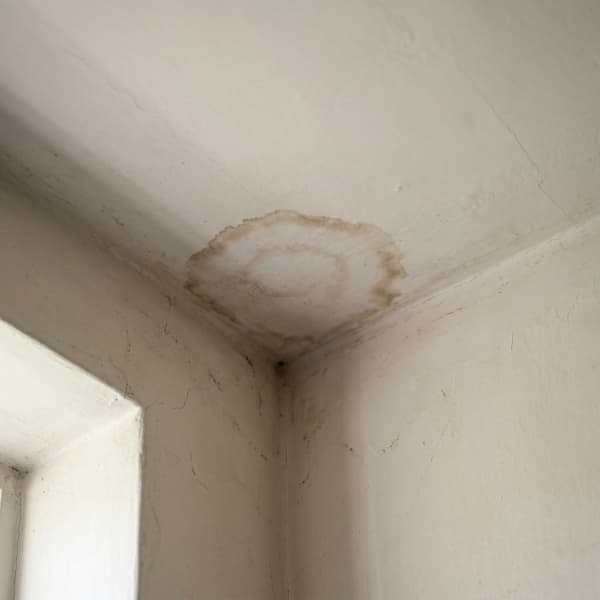
What Ice Dams Actually Damage
The ice itself is rarely the immediate problem. The damage comes from liquid water finding its way into the building envelope. Depending on how long the situation has gone on and how severe it is, this can mean:
- Stained or crumbling plaster and drywall
- Soaked insulation, which loses its R-value and can stay wet for months if not dried out
- Rot in roof decking, rafters, and fascia boards
- Damage to interior paint and finishes
- In severe cases, mold
On a slate or cedar shake roof, ice dams create additional risks. Slate is durable, but the flashing around chimneys, valleys, and dormers is often the vulnerability — and water backing up under ice can work its way through flashing joints that are perfectly fine under normal conditions. Cedar shake can absorb moisture and begin to deteriorate faster when repeatedly wet and frozen.
What You Should — and Shouldn’t — Do
First, the wrong approach: do not have someone attack your ice dam with a pick, a shovel, or a pressure washer. This is how you crack slate, split cedar, damage copper, and gouge asphalt shingles. We see this damage every spring. Well-intentioned emergency mitigation that causes more harm than the ice dam itself.
Calcium chloride ice melt can be used carefully — filled into a nylon stocking and laid perpendicular to the dam to create a channel for water to drain — but it won’t solve the underlying problem, and it should never go directly on copper or copper flashing, where it will cause accelerated corrosion.
A roof rake (a long-handled tool that lets you pull snow off the lower portion of the roof from the ground) is useful preventatively. Keeping the first several feet of roof surface clear of snow reduces the volume of meltwater that can back up.
The Real Fix
The permanent solution to recurring ice dams is almost never a roofing fix. It’s an insulation and ventilation fix. You need to reduce the heat escaping into the roof assembly, which typically means improving attic insulation (particularly at the eave area, which is often where coverage is thinnest), and ensuring you have adequate airflow from soffit vents to ridge vent so the roof deck stays uniformly cold.
This is attic and insulation work, not roofing work — though a good roofer should be able to diagnose the problem and point you in the right direction.
Where roofing work does come in: if you’ve had ice dams causing water infiltration for multiple seasons, it’s worth having someone properly assess the underlayment and flashing. Ice and water shield membrane, properly installed at the eaves and in valleys, provides a secondary line of defense. If your roof was built without it — which is common in older homes — adding it during any re-roofing work is worthwhile.
If you’ve had ice dam issues and you’re not sure what you’re dealing with, a roof assessment is a good starting point. We work across Connecticut and the Mid-Hudson Valley and we’re happy to take a look, give you an honest read on what’s going on, and tell you whether it’s a roofing issue, an insulation issue, or both.