
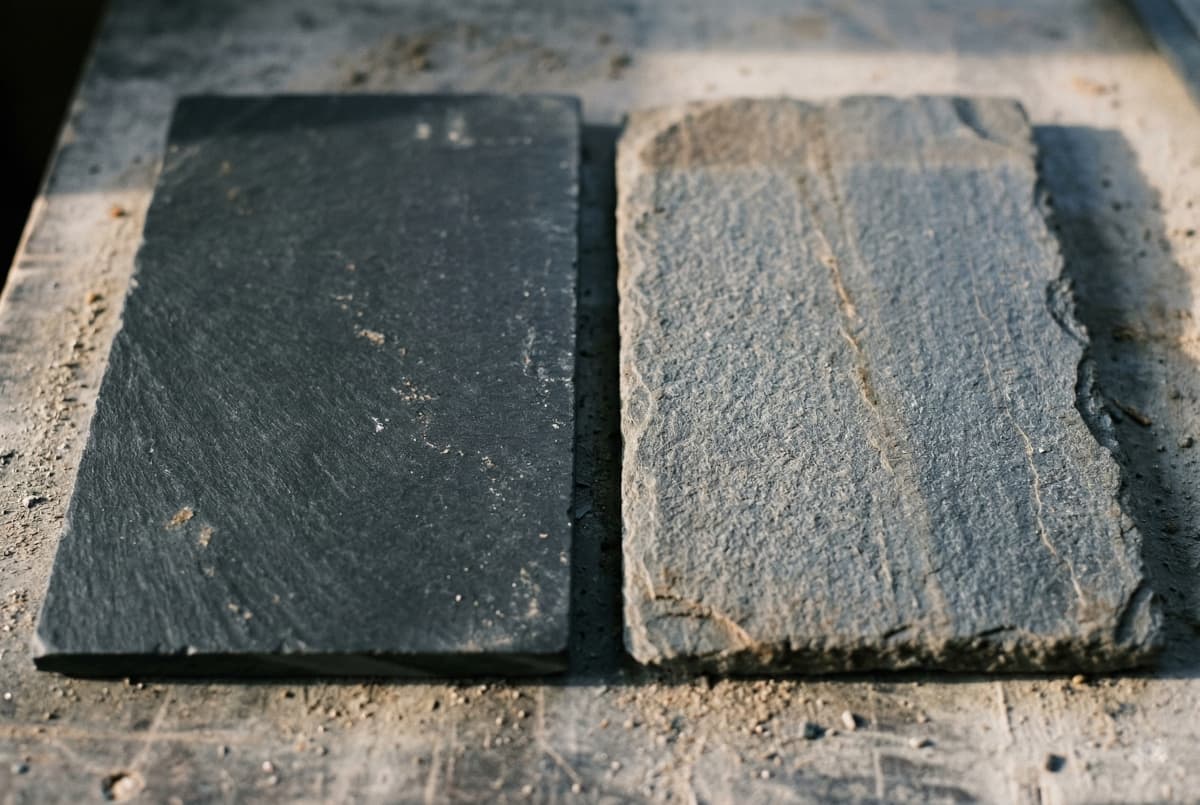
Hard Slate vs. Soft Slate
If you own a home with a slate roof, you’ve probably heard the word “slate” used as though it describes a single, uniform material. It doesn’t. Slate varies significantly depending on where it was quarried, and those differences have real implications for how long your roof will last, how it should be repaired, and what you can expect from it going forward.
The most important distinction — the one that affects almost every decision on a slate roof project — is whether you’re dealing with hard slate or soft slate.
When you tap a hard slate tile with your knuckle, it rings. That sound is 150 years of service life telling you it’s not done yet.


Hard Slate vs. Soft Slate: Where the Difference Comes From
Most of the slate you’ll find on historic homes in New England and the Hudson Valley came from one of several quarrying regions: Vermont, New York (particularly the Granville/Fair Haven district near the Vermont border), Pennsylvania (the Peach Bottom and Chapman Slate districts), and to a lesser extent Virginia and Maine.
These regions produce slates with meaningfully different characteristics, and the differences come down to geology. The mineral composition, the degree of metamorphic pressure the rock experienced, the presence or absence of certain impurities — all of this shapes how the material performs over time.
Hard Slate
Hard slate — primarily the dark gray and black varieties from Vermont and the Peach Bottom district of Pennsylvania — is exceptionally dense and durable. Properly installed, a hard slate roof will last 150 years or more. There are Vermont slate roofs in Connecticut that have been in continuous service since the 1880s. This is not an exaggeration. When you tap a hard slate tile with your knuckle, it rings. It has a clear, almost metallic sound.
Hard slate is also less porous, which means it absorbs less moisture through its annual freeze-thaw cycles. Over decades, this translates into dramatically less spalling and surface erosion.
Soft Slate
Soft slate comes primarily from the New York and Vermont regions that produce the colored varieties — the purples, greens, and mottled tones that are characteristic of many New England roofs. These slates are visually striking and were widely used in the late 19th and early 20th centuries. They’re real slate, quarried and split the same way, but they’re geologically less mature. Softer, more porous, and with a measurably shorter service life.
A soft slate roof installed in 1910 is approaching the end of its service life now. A hard slate roof installed in 1910 may have another 30 to 50 years in it. When you tap a soft slate tile, the sound is duller — a thud rather than a ring. After many decades of service, soft slates often show surface delamination, with the face of the tile beginning to flake and separate.
Why This Matters for Repair and Restoration
The practical consequence of this distinction is significant.
If you have a hard slate roof that’s 80 years old and generally in good condition — if the majority of the slates are sound, the flashing is intact or repairable, and you’re dealing with isolated breakage — restoration and ongoing repair is a very reasonable path. You may have many decades of service life remaining in the original material. Replacing it unnecessarily would be a genuine waste.
If you have a soft slate roof that’s 80 or 90 years old, the calculus is different. Individual slates may still be intact, but the material as a whole is aging. You may be at the point where the cost of ongoing repairs begins to approach the cost of a full replacement — and where a replacement makes more financial sense than continuously patching an aging surface.
The key is an honest assessment by someone who knows what they’re looking at. We’ve seen homeowners talked into full replacements on roofs with decades of hard slate life remaining, and we’ve seen homeowners spend years patching aging soft slate roofs that should have been replaced. Both outcomes involve wasted money.
Matching Replacement Slate
One nuance worth understanding: when we do repairs on a historic slate roof, we source replacement slate that matches the original material as closely as possible — not just in color, but in origin and hardness. Installing soft slate to patch a hard slate roof is a mistake that will show up within a few years as the replacement tiles age at a different rate than the surrounding material. On a historic property, it can also affect preservation designation.
We maintain relationships with suppliers who carry reclaimed slate from salvaged historic roofs, which can be an excellent option for matching both the appearance and the performance characteristics of original material.
Not Sure What You Have?
If you’re not certain whether your roof is hard or soft slate, or what condition it’s actually in, a professional assessment is the right starting point. We work across Connecticut and the Mid-Hudson Valley, and we can give you a clear, honest read on what you’re dealing with and what your options are — without any pressure toward a particular outcome.
Leave a Reply